
Hi, Sunshines,
experiment with these techniques to find what works best for you, and don’t be afraid to combine methods or adapt them to suit your learning style and the type of material you’re studying.
SQ3R Method
Survey, Question, Read, Recite, Review. This method involves previewing the material, formulating questions, actively reading, summarising or reciting key points, and reviewing the material.
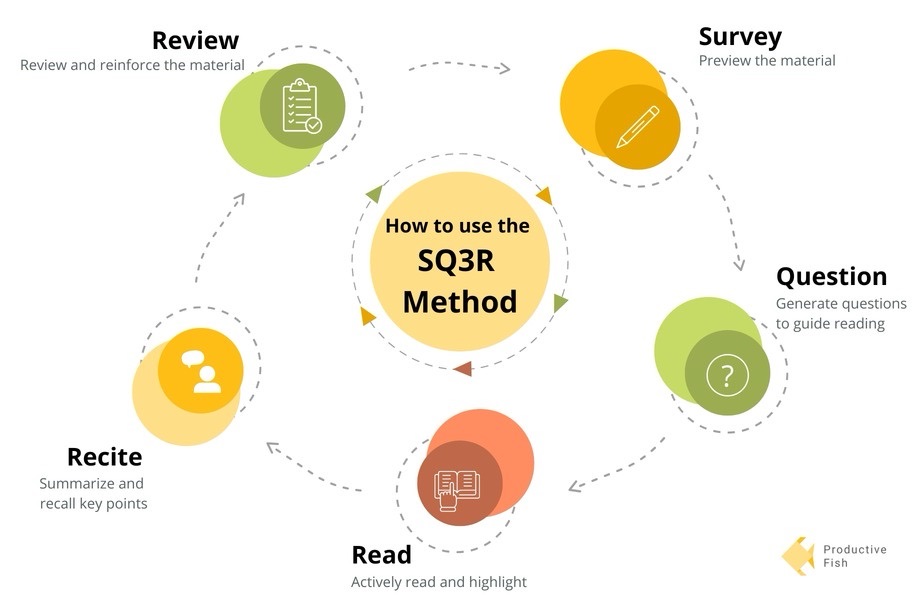
- Survey: Before diving into the text, quickly scan through the material to get an overview. Pay attention to headings, subheadings, bolded text, and any summaries or conclusions provided. This step helps you understand the structure and main points of the material.
- Question: Formulate questions based on the main points or headings you’ve identified during the survey. Think about what you want to learn or understand from the material. These questions guide your reading and help you stay focused.
- Read: Read the text actively, looking for answers to the questions you’ve formulated. Take notes, highlight important points, and annotate the text as needed. Try to understand the material rather than passively skimming through it.
- Recite: After reading a section or chapter, pause and recite or summarize the key points in your own words. This step reinforces your understanding of the material and helps commit it to memory. If you’re studying with others, you can also discuss the material or teach it to someone else.
- Review: Once you’ve finished reading the entire text, review your notes and summaries. Revisit the questions you formulated at the beginning and check if you can answer them confidently. Reviewing the material shortly after reading helps reinforce learning and ensures better retention.
By following the SQ3R Method, you actively engage with the material, which can lead to deeper understanding and improved retention of information. It’s a structured approach that can be applied to textbooks, articles, reports, and other written materials.
Feynman Technique
Explain the concept you’re studying in simple terms as if you were teaching it to someone else. This helps identify gaps in your understanding and reinforces learning.
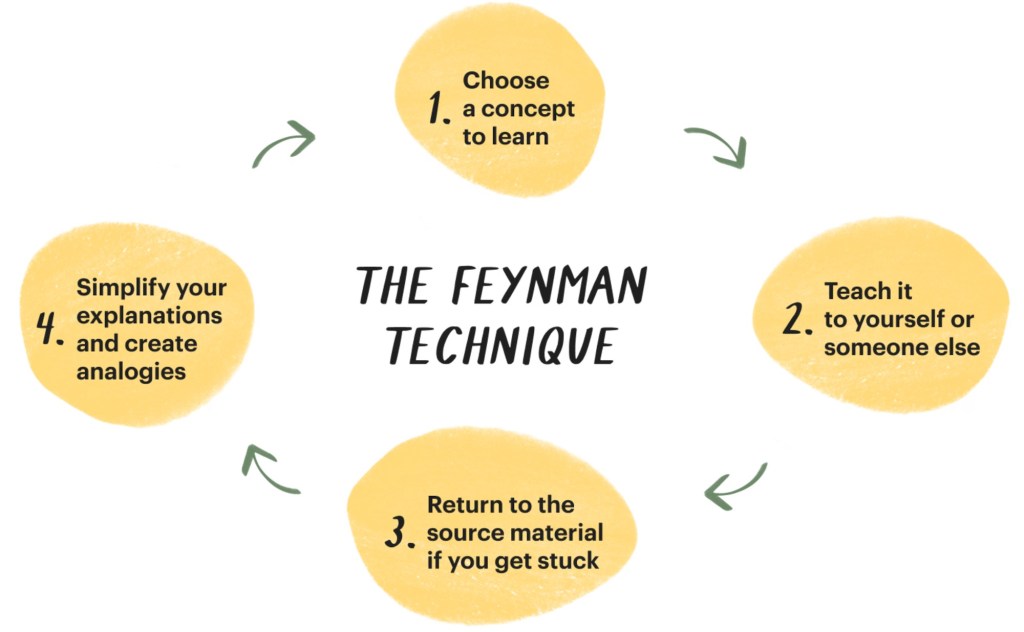
- Choose a Concept: Select the concept you want to understand or learn better.
- Teach it to a Child: Pretend you’re explaining the concept to a young child who has no prior knowledge of the subject. Use simple language and avoid jargon.
- Identify Gaps: As you explain the concept, pay attention to areas where you struggle to simplify or where you find gaps in your understanding.
- Review and Simplify: Go back to your source material to fill in the gaps and deepen your understanding. Break down complex ideas into simpler components and rephrase explanations until they’re easy to understand.
- Repeat: Keep practicing explaining the concept until you can do so clearly and confidently without relying on your source material.
By using the Feynman Technique, you not only gain a deeper understanding of the concept yourself but also identify areas where you need further study or clarification. It’s a powerful tool for mastering complex subjects and improving your overall comprehension.
Pomodoro Technique
The Pomodoro Technique is a time management method that uses a timer to break work into intervals, traditionally 25 minutes in length, separated by short breaks.
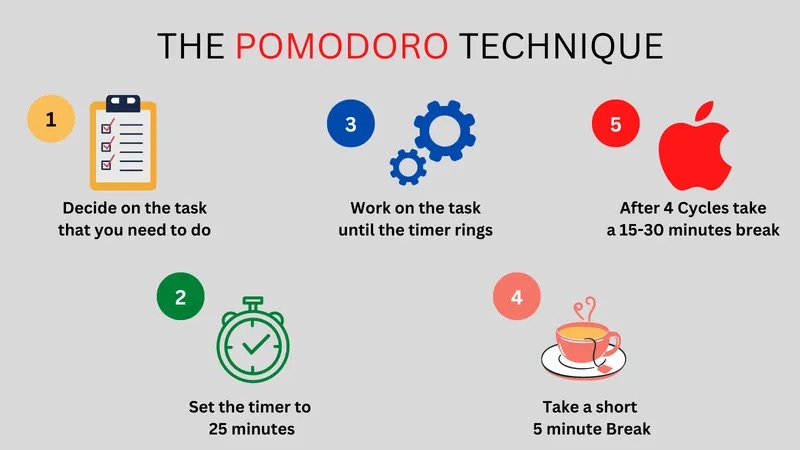
- Choose a Task: Select a task you want to work on.
- Set the Timer: Set a timer for 25 minutes, known as one Pomodoro interval.
- Work on the Task: Focus exclusively on the chosen task until the timer rings. Avoid distractions and interruptions during this time.
- Take a Short Break: When the timer rings, take a short break, typically 5 minutes. Use this time to relax, stretch, or do something unrelated to work.
- Repeat: After completing one Pomodoro interval and taking a short break, repeat the process. Work for another 25 minutes followed by a 5-minute break.
- Long Break: After completing four Pomodoro intervals (or “Pomodoros”), take a longer break, typically 15-30 minutes. Use this time to recharge before starting another set of Pomodoros.
The Pomodoro Technique helps improve focus and productivity by breaking work into manageable intervals and providing regular breaks to prevent burnout. It encourages a balance between focused work and relaxation, leading to increased efficiency and reduced mental fatigue.
Cornell Note-taking System
Divide your notes into sections for main points, supporting details, and summaries. Leave space for questions or cues, then review and summarize your notes after class.
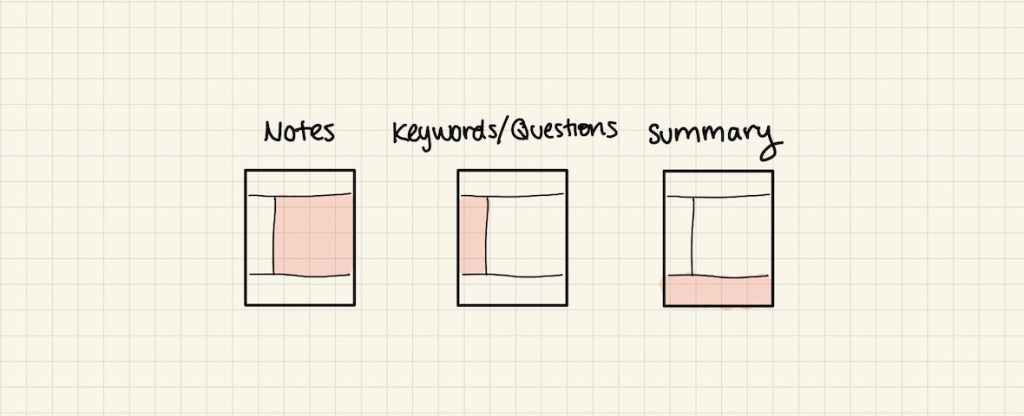
- Divide your paper: Draw a vertical line about 2.5 inches from the left side of the paper, creating a smaller left column and a larger right column. At the bottom of the page, leave space for a summary.
- Take notes: During the lecture or while reading, take notes in the larger right-hand column. Focus on capturing key points, main ideas, and supporting details.
- Use abbreviations and symbols: Use abbreviations and symbols to write quickly without sacrificing comprehension. This helps you keep up with the pace of the lecture or reading.
- Add cues/questions: In the left-hand column, jot down cues or questions based on your notes. These cues can help trigger your memory when reviewing later.
- Summarize: After the lecture or reading, write a summary of the main points at the bottom of the page. This summary should be concise and capture the essence of the material.
- Review and revise: Review your notes regularly, covering the right-hand column and using the cues/questions in the left-hand column to test your understanding. Revise your notes as needed and add additional information if necessary.
The Cornell Note-taking System helps you organize information effectively, encourages active engagement with the material, and provides a structured method for review and revision. It’s a versatile tool that can be used for various types of content, from lectures and presentations to textbooks and articles.
Leitner System
Use flashcards and a spaced repetition algorithm to prioritize reviewing information based on how well you know it. Cards you struggle with are reviewed more frequently.

- Prepare Flashcards: Write or create flashcards with questions or prompts on one side and corresponding answers or information on the other side.
- Divide into Boxes: Divide the flashcards into several boxes or groups, typically labeled Box 1, Box 2, Box 3, and so on.
- Initial Review: Start by reviewing all the flashcards. After each review session, sort the flashcards based on how well you know the material.
- Box System: As you review the flashcards, move them to different boxes based on your performance. Flashcards that you answer correctly are promoted to the next box, while those you struggle with are demoted to a lower box.
- Spaced Repetition: Schedule your review sessions based on the boxes. Flashcards in Box 1 are reviewed more frequently (e.g., daily), while those in higher boxes are reviewed less frequently (e.g., weekly or monthly).
- Gradual Promotion: With each successful review session, move the flashcards to higher boxes. Conversely, if you struggle with a flashcard during a review session, move it back to a lower box to increase its frequency of review.
- Long-term Retention: Over time, flashcards gradually move up through the boxes as you demonstrate mastery. This spaced repetition technique helps reinforce learning and promotes long-term retention of information.
The Leitner System allows you to focus more on challenging material while spending less time on material you already know well. It’s a flexible and adaptive method that can be customized to suit your learning pace and preferences.
Visualisation
Create mental images or diagrams to represent complex concepts. Visualising information can aid in understanding and retention.

- Conceptual Understanding: Visualizing complex ideas or concepts can make them easier to grasp. By creating mental images, you can break down abstract concepts into tangible representations that are easier to understand.
- Memory Enhancement: Visual imagery can improve memory recall by creating strong associations between information and visual cues. When you visualize information, you create multiple pathways for retrieval, making it easier to remember later.
- Creativity and Imagination: Visualization encourages creativity and imagination by allowing you to explore and manipulate mental images. This can lead to new insights, connections, and ideas.
- Problem Solving: Visualizing solutions to problems can help you brainstorm ideas and plan strategies more effectively. By visualizing different scenarios and outcomes, you can evaluate their feasibility and make informed decisions.
- Goal Setting: Visualizing your goals and aspirations can increase motivation and focus. By creating vivid mental images of your desired outcomes, you can clarify your objectives and stay committed to achieving them.
- Stress Reduction: Visualization techniques, such as guided imagery or visualization meditation, can promote relaxation and reduce stress. By imagining peaceful scenes or positive outcomes, you can calm your mind and alleviate anxiety.
To incorporate visualization into your learning process, try the following techniques:
- Mentally picturing concepts or ideas as if they were physical objects or scenes.
- Creating diagrams, mind maps, or sketches to represent information visually.
- Visualizing yourself successfully completing tasks or achieving goals to boost motivation.
- Practice guided imagery or visualization exercises to enhance relaxation and focus.
By harnessing the power of visualization, you can improve your learning, memory, and overall cognitive performance.
PQ4R Method
The PQ4R Method, also known as the Preview, Question, Read, Reflect, Recite, and Review Method, is a comprehensive approach to studying and understanding written material.
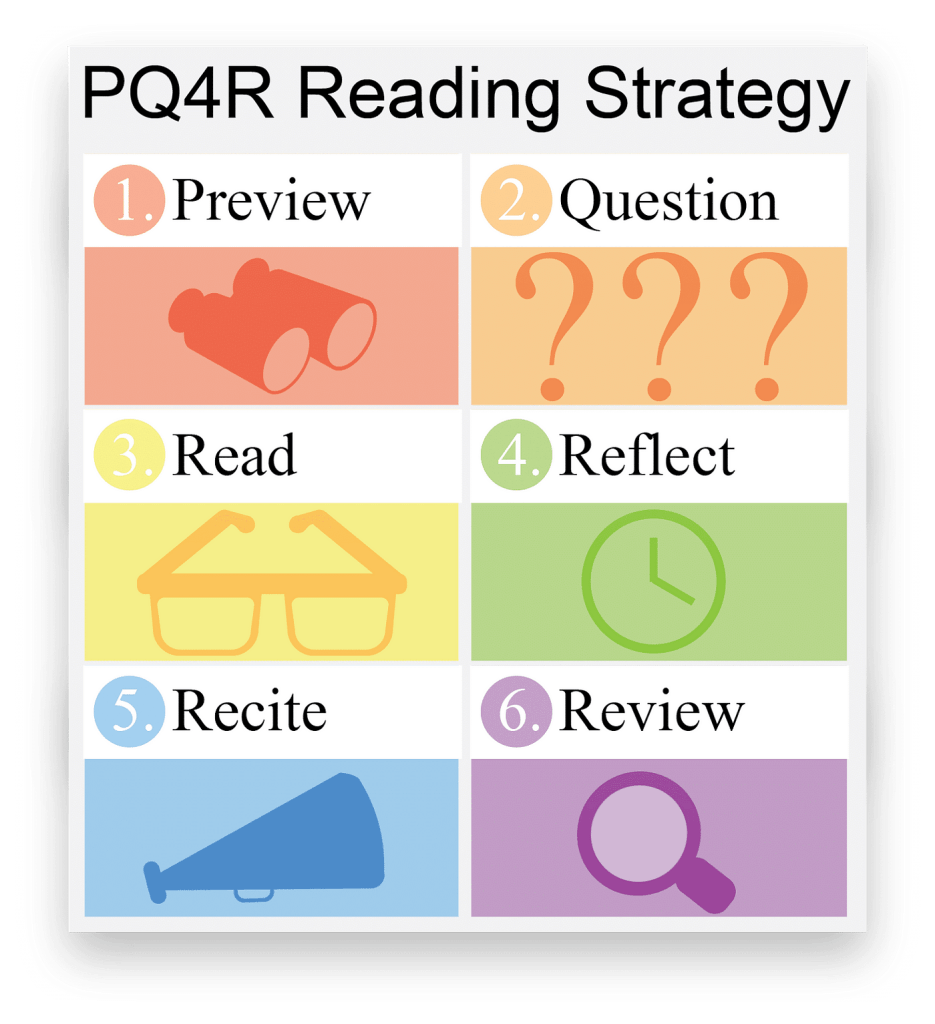
- Preview: Before diving into the text, skim through it to get an overview of the content. Pay attention to headings, subheadings, bolded text, and any summaries or conclusions provided. This step helps you understand the structure and main points of the material.
- Question: Formulate questions based on the main points or headings you’ve identified during the preview. Think about what you want to learn or understand from the material. These questions guide your reading and help you stay focused.
- Read: Actively read the text, looking for answers to the questions you’ve formulated. Take notes, highlight important points, and annotate the text as needed. Try to understand the material rather than passively skimming through it.
- Reflect: Pause periodically during your reading to reflect on what you’ve learned so far. Think about how the information connects to what you already know and consider any insights or questions that arise.
- Recite: After reading a section or chapter, pause and recite or summarize the key points in your own words. This step reinforces your understanding of the material and helps commit it to memory. If you’re studying with others, you can also discuss the material or teach it to someone else.
- Review: Once you’ve finished reading the entire text, review your notes and summaries. Revisit the questions you formulated at the beginning and check if you can answer them confidently. Reviewing the material shortly after reading helps reinforce learning and ensures better retention.
The PQ4R Method encourages active engagement with the material, deepens understanding, and promotes effective retention of information. It’s a structured approach that can be applied to textbooks, articles, reports, and other written materials.
Chunking
Break down large amounts of information into smaller, manageable chunks. Focus on one chunk at a time, mastering it before moving on to the next.
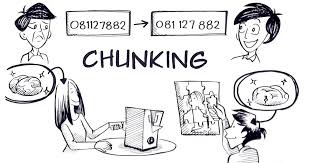
- Identify Units: Start by identifying the main units or components of the information you’re trying to learn. This could be sections of a text, steps in a process, or categories of information.
- Organize Information: Group related pieces of information together based on similarities or connections. Organizing information into meaningful chunks makes it easier to process and remember.
- Focus on Key Points: Instead of trying to memorize every detail, focus on the key points or main ideas within each chunk of information. This helps prioritize important information and reduces cognitive overload.
- Use Mnemonics: Create mnemonics or memory aids to help remember the information within each chunk. Mnemonics can be acronyms, rhymes, or visual images that represent key concepts or associations.
- Practice Retrieval: After studying each chunk of information, test yourself on what you’ve learned. Use retrieval practice techniques like active recall to reinforce memory and ensure understanding.
- Review and Reinforce: Regularly review the chunks of information you’ve learned and reinforce your understanding through spaced repetition. Revisiting the material at intervals over time helps solidify memory and prevent forgetting.
By using the chunking method, you can effectively manage and process large amounts of information, leading to improved learning and retention. This strategy is particularly useful for studying complex subjects, preparing for exams, or mastering new skills.
Active Recall Method
The active recall method is a powerful study technique that involves actively retrieving information from memory rather than simply reviewing it passively.
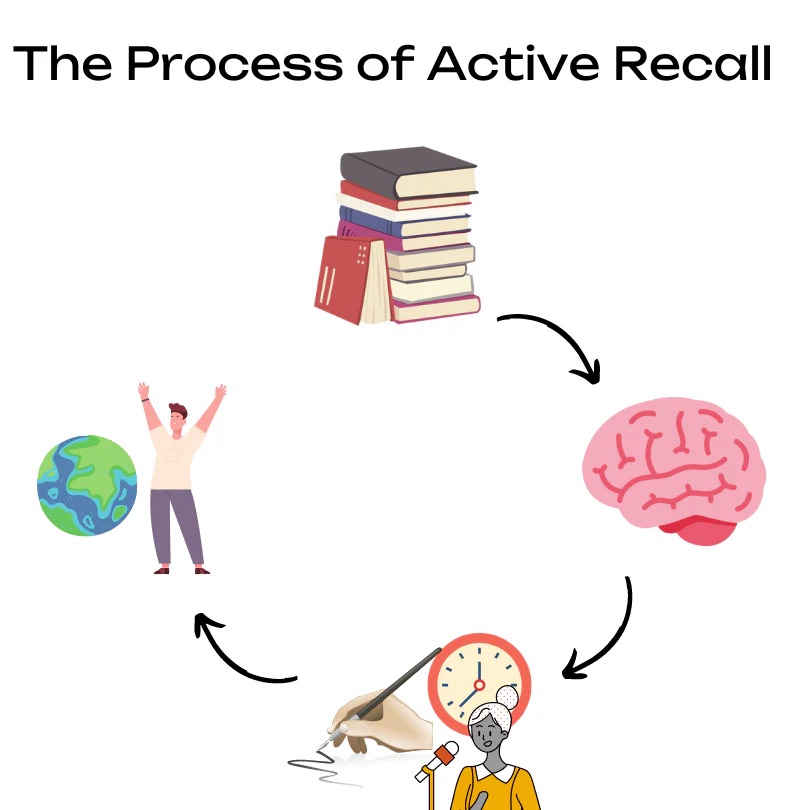
- Test Yourself: Instead of re-reading notes or textbooks, actively quiz yourself on the material. Cover up your notes and try to recall key concepts, definitions, or information from memory.
- Use Flashcards: Create flashcards with questions on one side and answers on the other. Test yourself regularly by going through the flashcards and actively recalling the answers.
- Practice Retrieval: Engage in retrieval practice by attempting to answer questions or solve problems without referring to your notes. This forces your brain to retrieve information from memory, strengthening neural pathways and enhancing retention.
- Space Out Practice: Space out your retrieval practice sessions over time to take advantage of the spacing effect, which suggests that information is better retained when it’s reviewed repeatedly with increasing intervals between sessions.
- Adapt and Review: Based on your performance during retrieval practice, adapt your study strategy and focus on areas where you need more review. Continuously review and revisit material to reinforce learning.
- Interleave Subjects: Mix up different topics or subjects during retrieval practice sessions rather than focusing on one topic at a time. This promotes deeper learning and better retention.
The active recall method is supported by cognitive psychology research and has been shown to be highly effective for improving learning, retention, and long-term memory. By actively engaging with the material and practicing retrieval, you not only strengthen your memory but also develop a deeper understanding of the concepts you’re studying.
Traffic Light System
The Traffic Light System is a method used to categorise and prioritize tasks or situations based on the colors of traffic lights: red, yellow, and green.
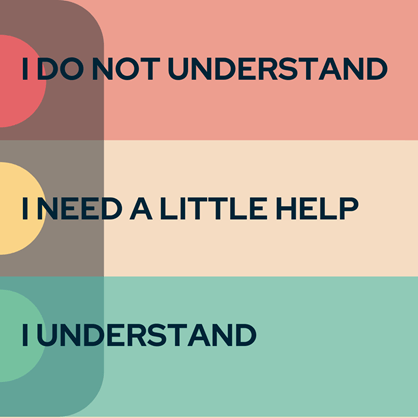
- Red Light (Stop): Identify tasks that are urgent and important, such as impending deadlines or high-priority assignments. These tasks require immediate attention, so you should stop what you’re doing and focus on completing them first.
- Yellow Light (Caution): These are tasks that are important but not necessarily urgent. They may include long-term projects, studying for upcoming exams, or completing assignments with flexible deadlines. While they may not require immediate action, it’s important to address them in a timely manner to prevent them from becoming urgent.
- Green Light (Go): These tasks are neither urgent nor important and can be deferred or delegated. Examples may include low-priority assignments, routine administrative tasks, or non-essential activities. You can either postpone these tasks until later or delegate them to someone else if possible.
By using the Traffic Light System, you can categorize your tasks or situations based on their urgency and importance, allowing you to prioritize effectively and allocate your time and resources accordingly. This approach helps you focus on what matters most and ensures that you’re addressing critical issues while also managing less pressing matters.
As you explore different study techniques, remember that finding what works best for you is key. Everyone’s learning style is unique, so it’s important to experiment and adjust your approach until you find the right balance. Whether you thrive with structured methods like time-blocking or prefer more creative techniques like mind mapping, the goal is to build a study routine that keeps you focused, efficient, and motivated.
No matter which strategies you adopt, consistency and self-care are just as important as the techniques themselves. Stay organized, keep your goals in sight, and don’t forget to take breaks to recharge. With the right methods in place, you’ll be well on your way to mastering your study sessions and achieving academic success.

Getting Your Life Back on Track: A Guide to Finding Balance and Purpose
Hello, everyone! In today’s post, I will help you survive this depressive season and put your life together. I don’t know about you, but October is just not my month. I always feel sucked up after this month. It feels like the air is full of negative energy, as the days get shorter and the…


Understanding the Healing Journey: Lessons from a Year of Self-Improvement
Learn the key steps for effective healing, what mistakes to avoid, and how to approach your personal growth journey in a realistic way.

The Winter Arc — A three-month reboot (Oct 1 → Jan 1)
Transform your body, mind, and habits this winter. Commit to 90 days of consistent workouts, healthy eating, journaling, reading, and discipline — and step into the new year stronger, focused, and glowing.
Site map
About
AeniShop
Beauty
Ideas
Journaling
Studies
Recipes
Wellness
Contact
Privacy Policy
Social
Instagram
YouTube
TikTok
Pinterest
Hi, Sunshines!
Subscribe now for exclusive content and special offers delivered right to you. Don’t miss out!
 aeni
aeni 
2 responses to “Top Study Techniques to Boost Your Learning Potential”
came from Reddit wow this is insane jnfo
LikeLike
[…] I have already written a post about study techniques, so check it out and find a suitable study technique for […]
LikeLiked by 1 person